


Last updated on August 24, 2026
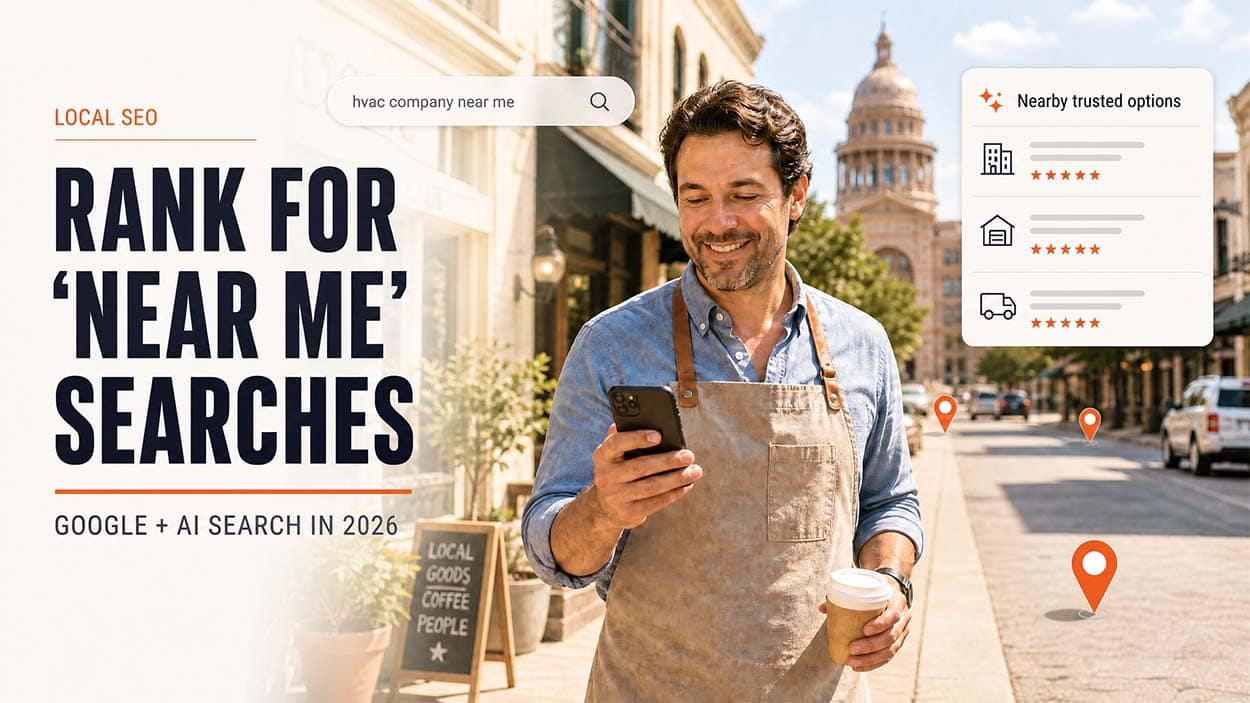
Ask any business owner in Central Texas what they want from the internet and the answer is almost always the same. They want the phone to ring when someone nearby needs exactly what they sell. That instinct is correct, and it has a name. Those are near me searches, and they are some of the highest-intent moments in all of digital marketing. When a homeowner in Temple types “plumber near me” or a driver in Killeen says “tire shop near me” into their phone, they are not browsing. They are ready to spend money, usually today.
The problem is that showing up for near me searches is not automatic, and it is not the same game it was three years ago. Google now leans on a local algorithm that weighs your Google Business Profile more heavily than your website. On top of that, a growing share of customers never see a traditional results page at all. They ask ChatGPT, Perplexity, or Google’s own AI Overviews for a recommendation and take the answer at face value. In this guide we walk through exactly how both systems decide who wins near me searches, and what your business can do to be the answer instead of the runner-up.

What Near Me Searches Really Mean for Local Businesses
A near me search is any query where someone is looking for a product or service close to their current location. Sometimes people type the literal words “near me.” More often they do not. When you search “coffee shop” on your phone, Google already knows you want coffee nearby, so it treats it as a local query and serves you a map with three businesses. That map is the local pack, and near me searches are what fill it.
These searches matter because the intent behind them is unusually strong. Google’s own research has long shown that the large majority of people who run a nearby search on their smartphone visit a related business within a day, and a meaningful slice of those searches end in a purchase. Think about what that means for a service business in Belton or Harker Heights. A person searching “AC repair near me” at two in the afternoon in July is not doing research for next year. They want cold air now, and they are going to call one of the first names they see.
That urgency is the whole reason these searches are worth chasing. The traffic is smaller than a broad national keyword, but it converts at a far higher rate because every searcher is a local person with a wallet out. Ranking for near me searches is not a vanity exercise. It is one of the most direct lines between search and revenue that a local business has.
How Google Decides Who Wins Near Me Searches
Google is refreshingly open about how local ranking works. According to Google Business Profile Help, local results are ordered by three factors: relevance, distance, and prominence. Understanding those three words is the foundation of everything else in this article, because local ranking is decided by how well you satisfy all three at once.
Relevance
Relevance is how well your business matches what someone is searching for. If a customer wants a roofer and your profile clearly says you are a roofing contractor, you are relevant. The way you signal relevance is by completing every field Google gives you: the right primary category, the services you offer, your hours, your description, and photos that show the work. A thin, half-finished profile leaves Google guessing, and Google does not rank guesses well.
Distance
Distance is how far your business is from the person searching, or from the location named in their query. This is the factor you cannot directly control, and it is why near me searches reward genuine local presence. A shop physically in Temple will usually beat one in Waco for a Temple searcher, all else equal. You cannot move your building, but you can make sure your address, service areas, and map pin are accurate so Google measures that distance correctly.
Prominence
Prominence is how well-known and trusted your business is. Google builds this picture from reviews, links, mentions across the web, and your overall reputation online. Prominence is the factor you have the most room to improve, and it is usually what separates two similar businesses competing for the same near me searches. The one with more and better reviews, more citations, and more links tends to win. Google is blunt about one thing here: there is no way to request or pay for a better local ranking. You earn it.
Independent research backs up how these factors are weighted. In BrightLocal’s Local Search Ranking Factors study, experts attributed roughly 32 percent of local pack ranking power to Google Business Profile signals and about 20 percent to reviews, with on-page content, behavioral signals, links, and citations filling out the rest. If you want to win near me searches, that breakdown tells you where to spend your time first.
Your Google Business Profile Is the Engine
If near me searches have a single most important lever, it is your Google Business Profile. This is the free listing that powers the map pack, and it is the first thing we audit for every local client we take on. A neglected profile is the most common reason a good business is invisible for the exact local searches it should own.
Start with the basics Google asks for. Verify your business so Google knows you are authorized to represent it. Fill in your complete name, address, and phone number, and make sure they match your website exactly. Choose the most specific primary category you can, then add secondary categories for your other services. Set accurate hours, including holiday hours, because a wrong “closed” label sends customers straight to a competitor.
Then go past the minimum. Add real photos of your team, your storefront, and your finished work, because Google uses fresh visual content as a quality and activity signal. Post updates through the profile the way you would post to social media. Answer the questions people ask in the Q&A section quickly, ideally within a day or two. Every one of these actions tells Google your business is active, legitimate, and worth surfacing for nearby customers. Profiles that sit untouched for months quietly slide down the rankings for near me searches while more engaged competitors climb.
Reviews and Ratings: The Local Trust Signal
Reviews are the second biggest driver of local pack rankings, and their weight keeps rising. BrightLocal’s data shows reviews grew from about 16 percent of local pack ranking influence in 2023 to roughly 20 percent in the most recent survey. That climb makes sense. Reviews are the clearest proof Google has that real people trust your business, and trust is exactly what it wants to reward in local rankings.
Volume, recency, and rating all matter. A steady stream of new reviews signals an active business, while a page frozen at eleven reviews from two years ago signals the opposite. Aim to build a simple, repeatable habit of asking every happy customer for a review, ideally with a direct link you text or email right after the job. Respond to every review you get, positive or negative. Google specifically notes that replying to reviews shows you value customer feedback, and thoughtful responses to criticism often impress future customers more than a wall of perfect five-star ratings.
Rating quality has taken on a new dimension in the AI era. Research from SOCi found that local businesses recommended by ChatGPT averaged about 4.3 stars, which suggests the AI tools are using rating thresholds as a filter for what they will recommend. In practical terms, a 4.7-star business with 120 reviews is in a far stronger position for near me searches, on both Google and AI platforms, than a 3.9-star business with 25. Reviews are no longer just social proof for humans. They are ranking fuel for machines.
On-Page Signals and Local Content That Reinforce Relevance
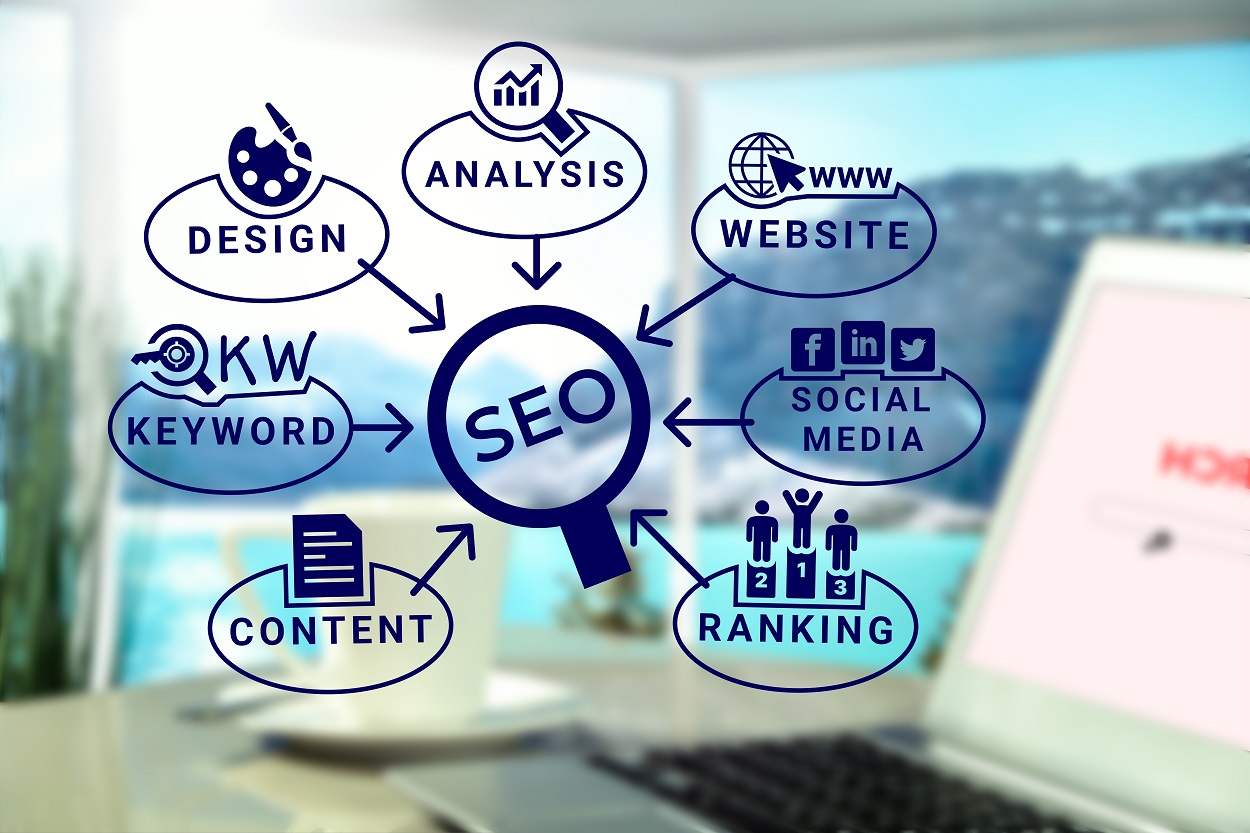
Your Google Business Profile does a lot of the heavy lifting, but your website still matters, especially for the organic results that sit below the map and for the AI tools that read your pages directly. On-page content is the single largest factor in local organic rankings, and it reinforces the relevance signal that near me searches depend on.
The most important move is building real location pages. If you serve Temple, Belton, Killeen, and Waco, a single “service areas” line on your homepage is not enough. Each city deserves its own page that names the location, describes the service in that community, and answers the questions local customers actually ask. That is why our own Central Texas location pages break out cities individually rather than lumping them together. Google reads those dedicated pages as strong evidence that you genuinely serve that area.
Write for how people actually talk. Near me searches are conversational, so your content should answer the natural questions behind them: how much does this cost, how fast can you come out, do you serve my town, what areas do you cover. Add a clear frequently asked questions section to your service and location pages. It helps human readers, it feeds featured snippets, and it gives AI tools clean question-and-answer pairs to pull from. If you want a fuller walkthrough of on-page work for a specific trade, our guide to local SEO for Central Texas contractors goes deep on the details.
Citations, NAP Consistency, and Local Links
Off your own site, two things quietly decide a lot of near me searches: citations and links. A citation is any online mention of your business name, address, and phone number, whether on Yelp, Apple Maps, Bing Places, Facebook, or an industry directory. Google cross-references these to confirm your business is real and consistent. If your phone number is different on three directories, you are handing Google a reason to doubt you.
The fix is not glamorous, but it works. Audit your listings across the major platforms and make your name, address, and phone number identical everywhere, down to the abbreviation of “Street” versus “St.” This NAP consistency directly affects how accurately AI tools describe your business, because they pull from these same directories. When the data agrees across the web, both Google and the AI engines trust it, and your odds in near me searches improve.
Local links add prominence on top of that foundation. A link from the Temple chamber of commerce, a local news story, a sponsored youth sports team, or a partner business tells Google you are woven into the community you claim to serve. You do not need hundreds of links. A handful of genuine, local, relevant ones will do more for near me searches than a pile of low-quality directory links ever could.
How AI Bots Answer Near Me Searches Differently
Here is the shift that is changing local marketing fastest. A growing number of people no longer scroll a results page for near me searches. They ask an AI. They open ChatGPT and type “who is the best HVAC company in Killeen,” or they let Google’s AI Overviews summarize the answer above the traditional links. Semrush has reported that AI Overviews already reach billions of users, and that traffic from AI search tools has grown enormously year over year. This is not a someday problem. It is happening now.
The uncomfortable truth is that AI tools are far pickier than Google’s local pack. SOCi research found that only about 1.2 percent of business locations were recommended by ChatGPT for local queries, compared with the roughly 36 percent that show up in Google’s local three-pack. In other words, the AI shortlist is dramatically shorter. Being one of Google’s top three is hard enough. Being the one business an AI names when someone asks for a recommendation is a higher bar, and it is quickly becoming its own competitive front in near me searches.
Where AI Tools Get Their Answers
The good news is that ranking in AI is not a mysterious new discipline. The AI engines draw from the same sources you already control. Google’s Gemini grounds its local answers directly in Google Maps data, which is why an accurate, complete Google Business Profile is just as vital for AI as it is for the map pack. ChatGPT and Perplexity lean on a mix of your website content, your reviews, and third-party directories and citations to build their picture of who you are.
That means the work compounds. A complete profile, consistent citations, strong reviews, and clear on-page content do double duty. They help you rank for traditional near me searches and they feed the exact data AI tools rely on. One piece that punches above its weight for AI is structured data. Adding schema markup to your site labels your business, services, and location in a language machines read without ambiguity, which makes you easier for an AI to understand and cite. We cover this in depth in our guide to schema markup and JSON-LD, and Google’s own LocalBusiness structured data documentation shows exactly which fields to mark up.
Answer-Ready Content Wins AI Recommendations
AI tools reward content that answers questions cleanly. Pages written as direct responses to real customer questions are easier for a model to lift and repeat than dense marketing copy. This is where a well-built FAQ section, clear service descriptions, and honest pricing guidance pay off twice. When your site plainly states that you serve Bell and Coryell counties, that you offer emergency service, and what a typical job costs, you give the AI clean facts to hand a searcher. Vague, salesy pages give it nothing usable, and it moves on to a competitor who made the answer easy.
The Near Me Searches Checklist for Central Texas Businesses
Theory is useful, but action is what moves rankings. Here is the practical checklist we work through with local clients who want to own near me searches across both Google and the AI tools. Start at the top and work down, because the earlier items carry the most weight.
- Claim and verify your Google Business Profile. Nothing else works until this is done and confirmed.
- Complete every profile field. Primary category, secondary categories, services, hours, description, and attributes.
- Match your NAP everywhere. Identical name, address, and phone on your site and every directory.
- Add fresh photos monthly. Real images of your work, team, and location, not stock photos.
- Build a review engine. Ask every satisfied customer, send a direct link, and reply to all reviews.
- Create a page for every city you serve. Name the location, describe the service, answer local questions.
- Add an FAQ to key pages. Answer the real questions behind your near me searches in plain language.
- Implement schema markup. LocalBusiness structured data so machines and AI tools read you correctly.
- Earn a few local links. Chamber, sponsorships, local press, and partner businesses.
- Keep it current. Update hours, post regularly, and re-audit citations a few times a year.
None of these steps is complicated on its own. The challenge is consistency, and that is usually where busy owners fall behind. The businesses winning near me searches are rarely the ones with the biggest budgets. They are the ones who do the fundamentals well and keep doing them month after month.

Questions to Ask Before You Trust a Local SEO Partner
Plenty of companies will promise to get you to the top of near me searches. Some are excellent. Some sell automated packages that do more harm than good. Before you hand this work to anyone, ask a few pointed questions. Will you optimize and actively manage my Google Business Profile, not just my website? How do you handle review generation and response? Do you build individual location pages, or one thin service-area page? Will you implement and validate schema markup? How do you plan for AI search, not just the traditional map pack?
A good partner will answer all of that plainly and show you real local results. If someone guarantees a number one ranking or refuses to explain their process, keep looking. Google itself says no one can buy or guarantee a local ranking, so any promise that sounds too clean is a warning sign. You want a team that treats near me searches as an ongoing discipline, because that is exactly what they are.
Frequently Asked Questions About Near Me Searches
How long does it take to rank for near me searches?
Most Central Texas businesses see meaningful movement in the local map pack within 60 to 90 days of consistent work on their profile, reviews, and citations. Competitive organic rankings and steady AI recommendations usually take four to six months to build. The timeline depends on how complete your profile already is, how strong your competitors are, and how aggressively you generate reviews.
Do I need a website if I have a Google Business Profile?
Yes. Your profile powers the map pack, but your website powers the organic results below it and feeds the AI tools that read your pages directly. The two work together. A strong profile with no website leaves ranking power on the table, and it gives AI engines less content to understand and cite when they answer near me searches.
Can I rank for near me searches in cities where I do not have an office?
To a degree. Google sets your Google Business Profile service area, and a dedicated, genuinely useful page for each city helps you appear in organic and AI results for those areas. But distance is a real ranking factor, so a business physically in that city will usually have an edge in the map pack. Honest, location-specific content is the right way to compete, not fake addresses, which violate Google’s rules.
How is ranking in ChatGPT different from ranking on Google?
The inputs overlap, but the bar is higher. AI tools recommend a far shorter list than Google’s three-pack, and they weigh review quality and clean, consistent data heavily. The same fundamentals that win Google near me searches, an optimized profile, strong reviews, consistent citations, and clear content, are what get you named by an AI. There is no separate trick, just a higher standard applied to the same signals.
Win Your Local Search With a Central Texas Partner
Near me searches are where local intent turns into local revenue. Google rewards the businesses that complete their profile, earn real reviews, publish genuine location content, and keep their data consistent everywhere. The AI tools reward those same signals, only they hand the recommendation to a shorter list of businesses that made themselves easy to trust and easy to understand. Do the fundamentals well and keep doing them, and you put your business in front of the people already reaching for their phones to find exactly what you offer.
That is the work we do every day for businesses across Temple, Belton, Killeen, Waco, and the wider Central Texas corridor. If you want to know where your business stands in near me searches right now, and what it would take to own them, take a look at our marketing services and then reach out through our contact page. We will audit your local presence before we ever make a recommendation, so you know exactly what you are getting.
Written by Matthew Wilson, MSIS, of Cen-Tex Marketing. Our team builds and manages local SEO, Google Business Profile optimization, and AI search visibility for service businesses across Waco, Temple, Killeen, Belton, and the Central Texas corridor. We treat near me searches as core infrastructure for local growth, not a set-it-and-forget-it afterthought.