


Last updated on August 24, 2026
A Central Texas business called us last year with a problem we now hear almost every week. Their website used to pull in well over a hundred organic clicks a day. Then, over a few months, that number collapsed into the low double digits. The cause was not a Google penalty or a botched redesign. It was AI Overviews, the AI-generated answers Google now drops at the very top of the search results, quietly eating the clicks this business had spent years earning.
This is a client spotlight on Grass Works Lawn Care, an Austin-area company we work with, and the exact playbook we used to win their traffic and leads back. We will walk through what AI Overviews did to their numbers, the seven moves we made across SEO, GEO, and paid search, and what the recovery looks like now. If your own organic traffic has slid for reasons you cannot quite explain, there is a good chance this story is yours too.
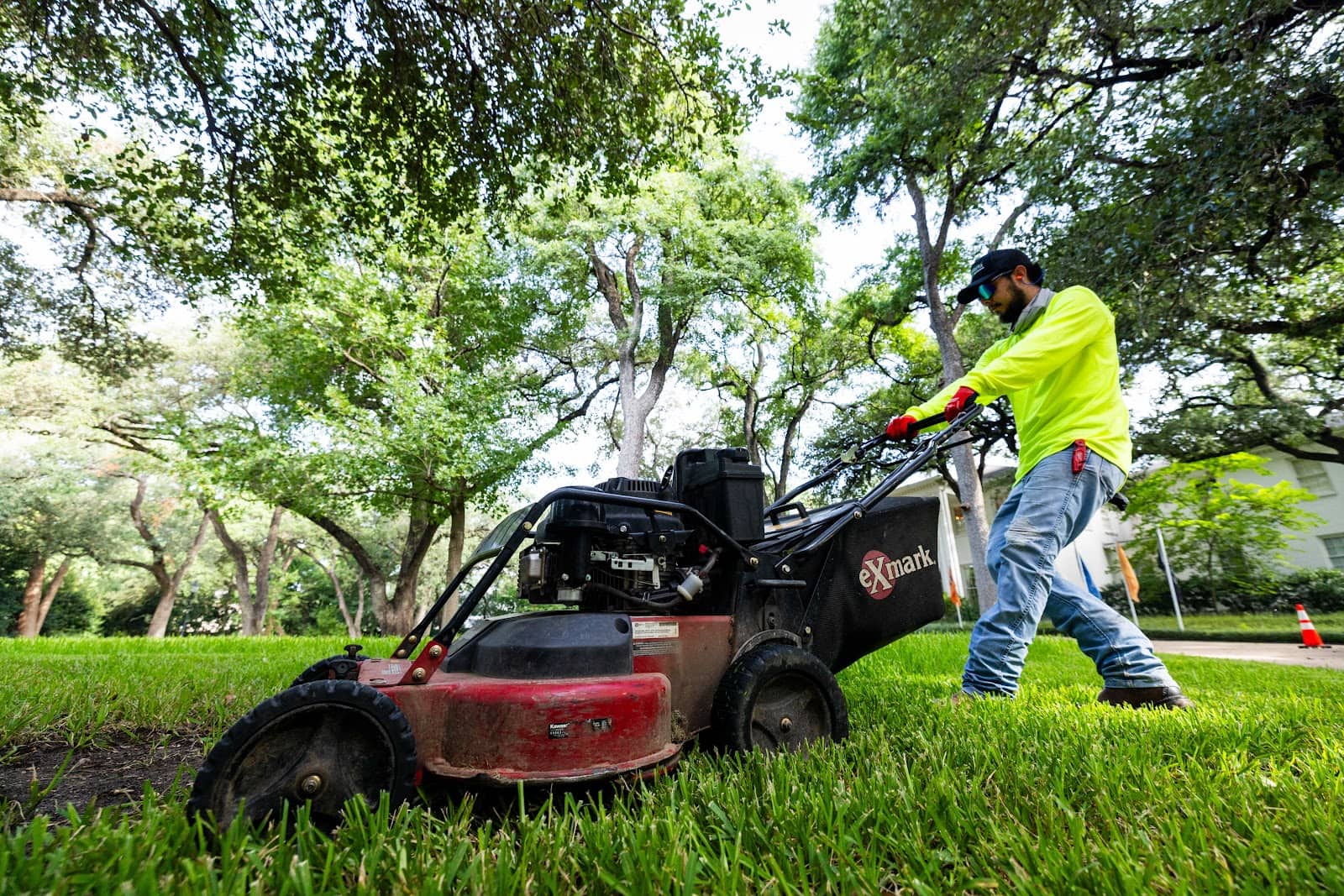
Meet the Client: Grass Works Lawn Care
Grass Works Lawn Care has served the Austin metro since 2007. They mow, design, install, and maintain lawns and landscapes across more than fifteen cities, from Cedar Park and Round Rock to Georgetown, Leander, Lakeway, and Highland Lakes towns like Marble Falls and Horseshoe Bay. They work both sides of the market: residential yards and commercial properties like HOAs, office parks, retail centers, multifamily communities, and golf courses. You can see the full scope of what they do over at grassworksaustin.com.
This is not a small operation. They hold a State of Texas irrigation license, carry more than five hundred five-star reviews, and maintain over two thousand properties. For years their website matched that reputation. It ranked well, and it produced a steady stream of quote requests without much paid support at all. That is exactly the kind of site AI Overviews tends to hurt the most, and that is precisely what happened.
When AI Overviews Changed the Math
The drop was not subtle. Their organic clicks fell by more than seventy percent over a matter of months. A site that comfortably pulled triple-digit daily traffic was suddenly landing in the low thirties. Leads followed the same curve, because fewer clicks means fewer phone calls and fewer form fills. When traffic is the top of your funnel, a collapse at the top drains everything below it.
We see this pattern constantly now, and the research backs it up. An Ahrefs study of 300,000 keywords found that AI Overviews cut the click-through rate for the top organic result by fifty-eight percent between December 2023 and December 2025. Their framing stuck with us: for every hundred clicks a top-ranking page used to earn, Google now keeps fifty-eight of them.
Read that again. More than half of the reward for ranking first can now evaporate before a single visitor reaches your site. That is what happened to Grass Works, and it is what these answers are doing to thousands of good local businesses that did nothing wrong except rank well for the kind of informational searches the AI now answers on its own.
Why AI Overviews Hit High-Ranking Pages Hardest
There is a cruel irony in all of this. The pages the AI damages most are often the best ones. When your content thoroughly answers a common question, Google’s AI can summarize that answer directly in the overview, satisfy the searcher, and remove any reason to click through. The better you taught, the less you get visited.
The Ahrefs numbers show the effect shrinks as you move down the page. Position one lost about fifty-eight percent of its clicks. Position five lost roughly a third. Position ten lost under twenty percent. In plain terms, the overviews punish the winners. Businesses that fought their way to the top of the results have the most to lose, which is exactly why the fix cannot be to simply try to rank harder.
So we built a different plan. If AI Overviews are going to answer the simple questions anyway, then the job becomes three things: earning trust for the queries that still convert, getting cited inside the AI answers themselves, and diversifying away from a single fragile traffic source. That reframing is where the real work started, and it shaped all seven moves that followed.
Move One: Rebuilding Every Page Around Google’s E-E-A-T
Google’s quality systems reward what it calls E-E-A-T: experience, expertise, authoritativeness, and trustworthiness. In Google’s own guidance on helpful content, trust is named the most important member of that group, and the others exist to support it. When AI Overviews decide which sources to summarize and cite, those same trust signals do a lot of the deciding.
We audited every important page on the Grass Works site through that lens. Who is behind this content? Why should a homeowner or a property manager believe it? We added real author information, credentials, and specific service-area detail. We rewrote thin pages into genuinely useful ones. We made the company’s experience visible rather than implied: the years in business, the irrigation license, the hundreds of reviews, the real projects.
This is the same people-first approach Google spells out for anyone trying to survive in an AI-driven results page. The goal was never to trick an algorithm. It was to make Grass Works so obviously the trustworthy local expert that both Google’s rankings and its AI answers would have a hard time leaving them out. We take the same approach for every service business we help, as we cover in our guide to local SEO for Central Texas contractors.

Move Two: A Backlink Campaign Built on Real Relationships
Trust is not only about what sits on your own page. It is also about who vouches for you. Backlinks, the links from other websites pointing back to yours, remain one of the strongest signals Google uses to judge authority, and they heavily influence which sources AI Overviews treat as credible enough to cite.
Grass Works had an advantage most companies do not. Years of commercial work had left them with real relationships: property managers, HOAs, builders, suppliers, and community partners who already knew and trusted them. We turned those relationships into an organized backlinking campaign, earning links from partners, vendors, local organizations, and relevant industry directories that genuinely made sense.
There were no purchased link schemes and no spam directories. Every link came from a legitimate connection, which is exactly the kind of link that holds up over time. That distinction matters more than ever, because the trust those links build is a big part of how a site earns its way back into visibility, and back into the AI answers, after the traffic drop.
Move Three: A Full Technical SEO Audit
While the content and links improved, we tore into the technical foundation underneath the site. A business can have great content and still get buried if search engines struggle to crawl it, understand it, or load it quickly. So we audited all of it, page by page, and fixed what was holding the site back.
The two biggest levers were structured data and speed. We implemented and cleaned up schema markup so Google could read exactly what each page represented: the business, its services, its locations, and its reviews. Clean structured data is one of the most direct ways to make your content easy for AI Overviews to parse and cite correctly. We break the whole topic down in our guide to schema markup and JSON-LD.
We also fixed the plumbing. Server-side caching, image compression, tightened-up code, and better core web vitals meant pages loaded fast on the phones most local searchers actually use. Fast, well-structured pages are easier for Google to trust and easier for the AI to pull from without garbling the details. Technical SEO is unglamorous, but it is the floor everything else stands on.
Move Four: Optimizing for AI Overviews and GEO
Traditional SEO tries to rank a page. GEO, or generative engine optimization, tries to get your business mentioned and cited inside AI-generated answers like AI Overviews, Google’s AI Mode, and tools like ChatGPT. It is the natural next step once you accept that a real chunk of search now happens without anyone clicking a classic blue link at all.
Here is the reassuring part. In its documentation on AI features, Google says there are no secret tricks required to appear in AI Overviews. The same fundamentals apply: be indexed, be eligible for snippets, present important information as text, support it with quality images and video, and keep your structured data aligned with what visitors actually see on the page.
So our GEO work for Grass Works was not some separate dark art. We structured content to answer real questions directly, added clear headings and concise summaries the AI could lift cleanly, reinforced the business as a consistent entity everywhere it appears, and made sure the pages most likely to be summarized still gave a reason to click, through local specifics, offers, and strong calls to action. The aim is simple. If AI Overviews are going to answer the question, Grass Works should be one of the sources doing the answering.
Move Five, Six, and Seven: Google Ads That Actually Work
Rebuilding organic trust takes months. Leads cannot wait that long, so at the same time we took over the Grass Works Google Ads account. Paid search became the bridge that kept the phone ringing while the SEO, technical, and GEO work matured in the background. Those were moves five, six, and seven: restructure the account, rewrite the ads, and build real landing pages.
The account needed genuine management, not autopilot. We restructured the campaigns, tightened match types and negative keywords, rewrote the ad copy, and improved Quality Score so the same budget bought far more clicks. Then we built a dedicated landing page for each ad, so the traffic we paid for landed somewhere designed to convert instead of a generic homepage that made visitors go hunting.
The result was a dramatic reduction in cost per click, a multiple rather than a few percentage points, while conversion rates on the new landing pages held strong. Cheaper clicks plus pages that actually convert is the entire game in paid search. If your own cost per lead is creeping the wrong direction, we broke down the usual reasons in our piece on why your Google Ads cost per lead keeps climbing.
The Results, and What Actually Changed
The recovery is real and still building. Organic trust signals are climbing again, the technical foundation is solid, and Grass Works now shows up inside AI answers for many of the searches that matter, rather than being summarized out of the picture. The backlink profile is stronger and more legitimate than it has ever been, and the site is once again earning quote requests it was losing a year ago.
On the paid side, the cheaper clicks and conversion-focused landing pages mean the ad budget works far harder than it used to. Between recovering organic leads and a much more efficient paid program, the business is capturing demand again instead of watching the AI quietly siphon it off. None of this came from a single silver bullet. It took a coordinated push across SEO, GEO, technical work, backlinks, and PPC, because no one of those would have been enough on its own.

What to Do If AI Overviews Are Eating Your Traffic
If your organic traffic has quietly fallen and you cannot pin down why, AI Overviews are a prime suspect. Here is the short version of what we would look at, pulled straight from the Grass Works playbook. Run through it honestly and you will usually find the gaps.
- Measure the real damage. Compare organic clicks and impressions year over year in Search Console, and note which of your top pages now trigger an AI Overview.
- Audit your E-E-A-T. Make authorship, credentials, experience, and reviews obvious on the page. Trust is what earns a citation.
- Get your structured data right. Clean schema markup helps Google and AI Overviews understand and quote your pages accurately.
- Build real backlinks. Earn links from partners, suppliers, and local organizations that genuinely know you. Skip the shortcuts.
- Fix the technical basics. Caching, speed, mobile experience, and crawlability are the floor, not the finish.
- Optimize for GEO. Answer real questions directly and structure content so AI Overviews can lift and cite it cleanly.
- Diversify with well-run paid search. A tightly managed Google Ads account keeps leads flowing while organic recovers.
You do not have to run all seven at once. But you do have to treat this as a system rather than a single quick fix, because that is how the traffic left and that is how it comes back. If budgeting the work is the sticking point, our guide to a realistic Central Texas marketing budget lays out how to fund it without guesswork.
Quick Answers: AI Overviews and Your Traffic
What are AI Overviews, exactly?
AI Overviews are the AI-generated summaries Google places at the top of many search results. They pull from multiple sources to answer a query directly on the results page, which often means the searcher gets what they need without clicking any website. That convenience for users is what makes AI Overviews so disruptive for businesses that rely on organic traffic.
How much traffic can AI Overviews really take?
More than most owners expect. The Ahrefs study of 300,000 keywords found AI Overviews cut clicks to the top result by fifty-eight percent. Our client saw organic clicks fall more than seventy percent. The exact number depends on your industry and how many of your queries are informational, but for most local businesses the impact is large and worth acting on.
Can I keep my content out of AI Overviews?
You can, using tags like nosnippet, max-snippet, and noindex, but we rarely recommend it. Hiding from these answers usually means hiding from regular search too, which costs you far more than it saves. The better play is to be cited inside the overview and to give people a compelling reason to click through to you anyway.
How long does recovery take?
Plan on months, not weeks. E-E-A-T improvements, backlinks, and technical fixes compound over time rather than flipping a switch. That is exactly why we run paid search alongside the SEO and GEO work, so leads keep coming in while the organic side rebuilds the trust AI Overviews now demand.
The Bottom Line
AI Overviews changed the rules for every business that depends on being found on Google. Grass Works Lawn Care did not do anything wrong. They simply ranked well in a world that suddenly started answering searchers before those searchers ever reached their site. The fix was not one clever trick. It was a coordinated rebuild of trust, structure, links, technical health, and paid search, all pointed at the same goal.
If your own traffic has slipped and AI Overviews look like the reason, that same playbook will work for you. Reach out through our contact page and we will take an honest look at where your traffic went and what it will take to win it back. We review every site before we make a single recommendation.
Written by Matthew Wilson, MSIS, of Cen-Tex Marketing. Our team builds and manages SEO, GEO, structured data, and Google Ads for service businesses across Waco, Temple, Killeen, Belton, Austin, and the wider Central Texas region. We treat AI Overviews as a challenge to be engineered around, not an excuse to accept lost traffic.