


Last updated on August 24, 2026
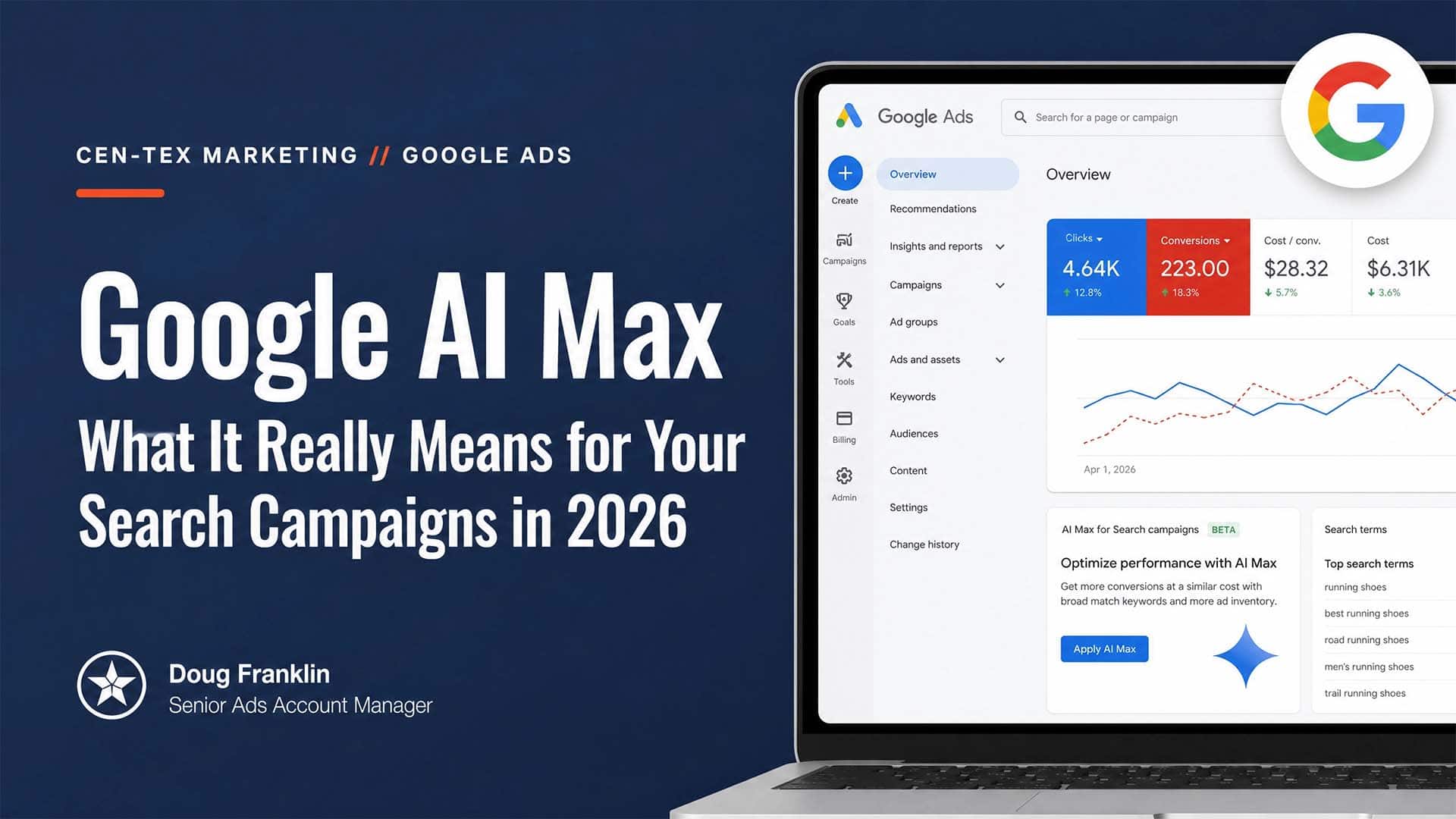
Here is the uncomfortable truth about the biggest change coming to paid search this year. Google AI Max is not something you get to opt into on your own quiet schedule. It is already rolling out across accounts, and by the end of September 2026 a large chunk of it becomes automatic whether you raise your hand or not. I have managed paid search long enough to know one thing for certain. The advertisers who win these transitions are the ones who understand the machine before it changes on them.
So let me save you the panic. Google AI Max is not the end of the keyword. It is not Performance Max wearing a Search costume. And it is not a reason to hand Google your credit card and walk away. It is a set of AI powered features bolted onto the Search campaigns you already run. Used well, it finds profitable searches you were missing. Used carelessly, it quietly spends your money on traffic that will never call you.
This is the honest, working professional breakdown. What Google AI Max actually does, the numbers Google would rather you skim past, the deadline you cannot ignore, and the exact way our team turns it on for clients without lighting the account on fire. If you are shopping for someone to run your ads, the questions near the end will also tell you what good looks like before you sign anything.
What Google AI Max Actually Is, and What It Is Not
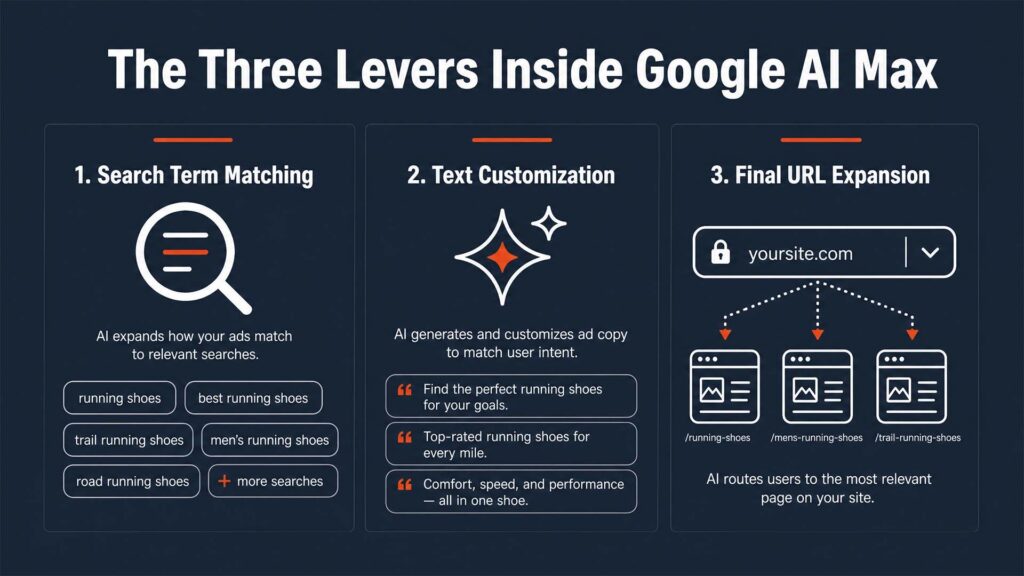
Let me define this cleanly, because the marketing fog around it is thick. Google AI Max for Search is an optional enhancement layer that sits on top of the Search campaigns you already have. It is not a new campaign type. You do not rebuild anything from scratch. You flip it on inside an existing campaign, and Google’s AI starts doing three specific jobs on top of your keywords.
The distinction matters more than the branding suggests. Performance Max asks you to give up the keyword, the search term report, and most of your visibility in exchange for cross channel reach. Google AI Max does close to the opposite. It keeps you inside Search. It keeps your keywords. It keeps your search term transparency. You are still the one driving. The AI is riding along, suggesting turns you might not have taken.
Here is the context most write ups bury. This product was announced at Google Marketing Live in May 2025, ran a global beta through the back half of 2025, and picked up one click experiments and Smart Bidding Exploration by September 2025. This is not a rumor about the future. It is a live product with real spend flowing through it right now, and the rollout is speeding up, not slowing down.
If you run Dynamic Search Ads today, this is doubly your problem, and I will get to exactly why in a minute. For everyone else, think of Google AI Max as Google finally admitting that rigid keyword lists leave money on the table, then building a system to chase the searches your keywords never covered. That admission is fair. What you do with it is where the money is won or lost.
The Three Levers Inside Google AI Max
Every honest conversation about Google AI Max has to start with what it actually changes under the hood. There are three levers. Each one is a gift and a liability at the same time, depending entirely on how tightly you choose to hold it.
Search term matching
The first lever is search term matching. The system uses broad match and what Google calls keywordless technology to find relevant queries based on your keywords, your landing pages, your ad assets, and your final URLs. Your exact match keywords still get priority in the auction. The AI is mostly hunting for the searches you never thought to add to the account. When your negatives are tight and your tracking is clean, this is where the upside lives. When they are loose, this is where the waste hides.
Text customization
The second lever is text customization. Google AI Max uses Google’s Gemini model to generate headlines and descriptions on the fly, reading your landing page and the searcher’s intent to write copy in the moment of the auction. If you have ever spent hours crafting ad copy in your brand voice, this should make you sit up straight. The machine is now writing in your name. That is powerful and it is genuinely dangerous, which is precisely why the brand and text controls matter as much as they do.
Final URL expansion and locations of interest
The third lever is final URL expansion. Instead of always sending a click to the URL you picked, the system can route a searcher to whatever page on your site it decides fits their query better. Alongside it sits a locations of interest setting that targets people by the geography they are searching about, not only where they happen to be sitting. For a service business that lives and dies on the Austin DMA, that geographic control is not a footnote. It is close to the whole ballgame.
Put the three levers together and you can see the shape of the thing. Google AI Max widens who sees your ad, rewrites what your ad says, and can change where your ad sends people. Three powerful moves, each one made by a machine, each one aimed at your budget. The advertisers who thrive are the ones who decide in advance which of those moves they will supervise and which they will restrict.
Why Google AI Max Fits, and Fights, a Message Coherence Framework
Our entire approach to Google Ads management rests on one stubborn idea. The conversation has to stay the same from the ad, to the page someone lands on, to the phone call with your team. Break that chain anywhere and your cost per lead climbs. Now look back at those three levers, and you can see why Google AI Max is both a natural fit for that principle and a real threat to it.
On the fit side, search term matching is just a smarter way to chase relevant demand, which is exactly what tight, service specific campaigns are supposed to do in the first place. If you have already built ten to twenty tightly grouped keywords per service, the tool can extend that structure into profitable queries you would have missed on your own. It works with your discipline instead of against it. The same is true for customer type and location campaigns. When each campaign already speaks to one audience in one place, the AI has a clean, unambiguous signal to expand from, and expansion built on a clear signal is the kind that actually pays.
On the threat side, final URL expansion and Gemini written copy can quietly snap the chain. If the AI sends a commercial roofing searcher to your residential landing page, or writes a headline that promises something your intake team never says on the phone, the conversation breaks. The click still costs you. The lead still does not close. This is the exact failure our team spends its days preventing, and Google AI Max can reintroduce it at scale if nobody is watching the account closely.
So the honest answer is not to fear the tool and it is not to trust it blindly. The answer is to hold the levers you have to hold. Lock down the brand controls. Exclude the pages that should never receive paid traffic. Feed the system clean conversion data so it optimizes toward real booked leads instead of vanity clicks. Google AI Max is a strong instrument inside a disciplined framework and a fast way to burn budget outside of one. The framework is the point. The feature is just the amplifier.
The Dynamic Search Ads Deadline You Cannot Ignore
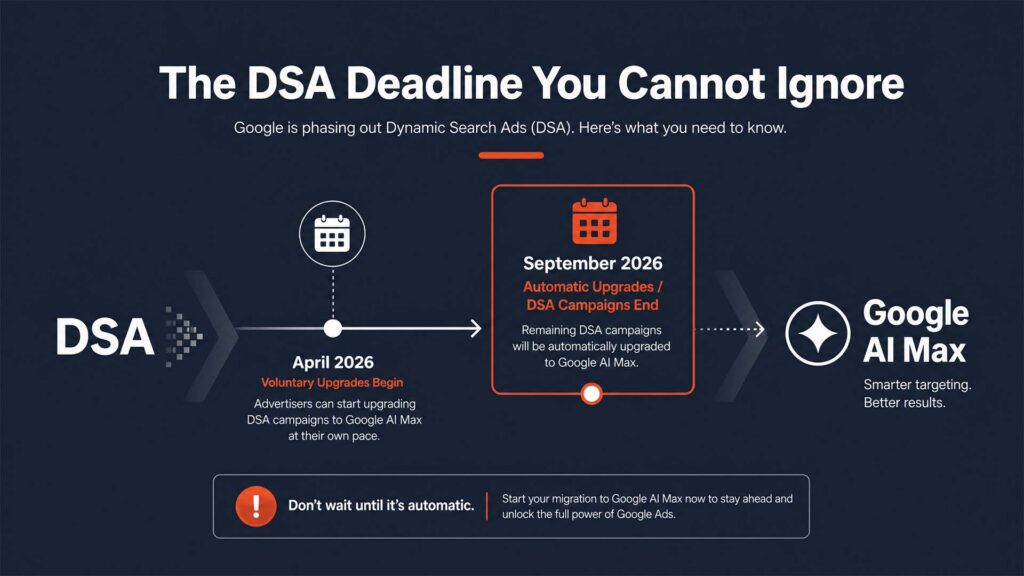
If you are running Dynamic Search Ads, Google AI Max is not optional and the clock is not far off. Google has published the timeline in plain language, and it is tighter than most self managed advertisers realize.
Starting in April 2026, Google opened voluntary upgrades, handing DSA advertisers the tools to move campaigns over on their own terms. In September 2026, the automatic upgrades begin, and you can no longer create a new Dynamic Search Ads campaign anywhere. Not in the interface. Not in Google Ads Editor. Not through the API. By the end of September 2026, every eligible campaign is expected to be upgraded to Google AI Max.
Read that again if you manage your own account. The product you may be leaning on right now has a shut off date this year. Google says the upgrade mirrors your legacy settings to keep performance steady, and that legacy URL controls are preserved for DSA users through the move. I believe the intent is continuity. I also know from experience that automatic migrations are exactly when accounts drift, budgets wander into the wrong campaigns, and nobody notices until the monthly numbers look strange.
The smart move here is not to wait for the September deadline to arrive on its own. It is to upgrade on your own schedule, with a plan and a test, while you can still watch every change happen in daylight. A migration you control is a tuneup. A migration that happens to you is a gamble.
The Numbers Nobody Puts on the Sales Slide
Here is where I earn my keep. Google’s own numbers for Google AI Max are genuinely strong, and I am not going to pretend otherwise. The company reports a 14 percent average lift in conversions, and a 27 percent lift for campaigns that lean heavily on exact and phrase match keywords. It says advertisers using the full feature suite, meaning search term matching plus text customization plus final URL expansion, see about 7 percent more conversions or conversion value at a similar cost per acquisition compared to using search term matching alone.
Pair the system with Smart Bidding Exploration and Google cites an 18 percent increase in unique converting search query categories and a 19 percent lift in overall conversions. Those are real figures from real tests. They are also, every one of them, the figures on the sales slide. And the sales slide never shows the other side of the room.
The other side of the room looks like this. In independent testing, roughly 84 percent of advertisers who tried Google AI Max reported neutral or negative results. Let that number land for a second. More than four out of every five saw no meaningful gain or an outright loss. The 16 percent who won were not lucky. They shared a very specific profile. Strong conversion tracking. Comprehensive negative keyword lists. Genuinely good landing pages, not one lonely page doing all the work. More than a hundred conversions a month. And a history of broad match already working for them before they ever touched the new tool.
That gap between Google’s glossy average and the typical advertiser’s lived reality is the entire story of Google AI Max in one sentence. The tool is not magic and it is not a scam. It is an amplifier. It multiplies whatever discipline, or whatever sloppiness, already exists in the account you point it at. If your account is tight, it makes you tighter. If your account leaks, it helps you leak faster.
The Prerequisites We Check Before We Turn Google AI Max On
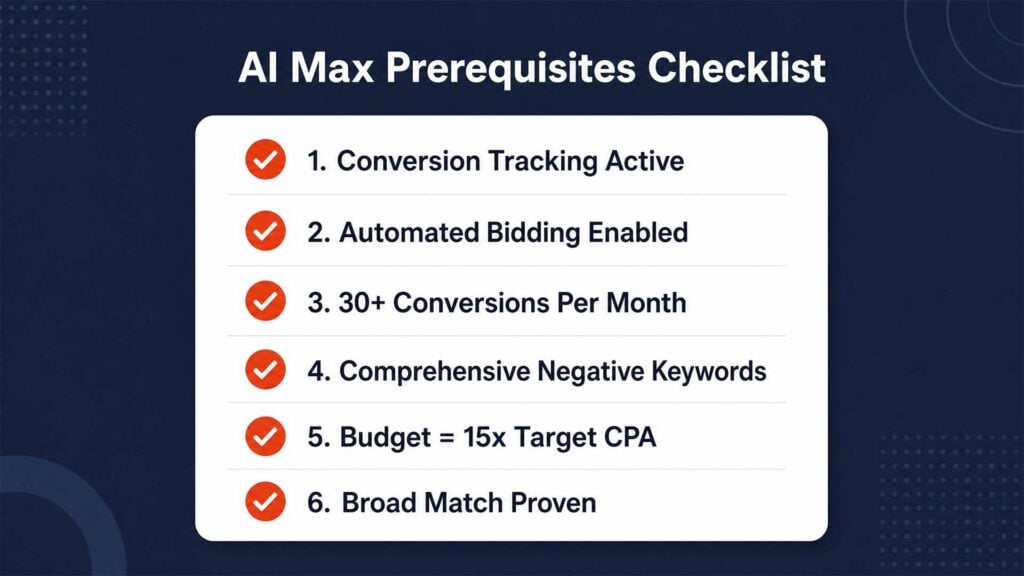
Because Google AI Max amplifies whatever it finds, we do not flip it on for a client until the foundation can survive being amplified. Here is the checklist our team actually runs. If you are managing your own account, run it on yourself honestly before you go anywhere near that setting.
- Conversion tracking that counts real leads, with Enhanced Conversions turned on. The AI optimizes toward whatever you tell it is a win, so if you are counting form page loads and button clicks instead of booked calls, garbage in becomes expensive garbage out.
- Automated bidding already in place. The system needs Target CPA, Target ROAS, Maximize Conversions, or Maximize Conversion Value to function. Manual CPC simply does not work with it, so this is a hard requirement, not a preference.
- At least 30 conversions a month, and ideally 100 or more. Below 30, results swing wildly because the machine never gathers enough signal to learn what a good lead even looks like for you.
- A daily budget of roughly 15 times your target cost per acquisition, so the system has room to explore new queries without starving the proven keywords that already pay your bills.
- A comprehensive negative keyword list. This is the single biggest predictor of whether the tool helps or hurts, because expansion without exclusions is just a faster, more confident way to buy the wrong clicks.
- Real evidence that broad match already works in the account. If broad match has historically bled money for you, this tool will bleed it faster and with more conviction. Fix that leak first, then come back.
None of this is exotic. It is blocking and tackling, the unglamorous fundamentals of paid search. But notice something about that list. Every prerequisite is something a careful manager controls on purpose and an autopilot account ignores by default. That is not an accident. Google AI Max rewards the operators who were already doing the work, and it punishes the ones who hoped automation would let them skip it.
How We Roll Out Google AI Max Without Torching the Account
Once the foundation checks out, the rollout itself is a discipline, not a light switch. This is where respecting the machine’s rules actually pays for itself instead of costing you.
We never simply enable Google AI Max across a live campaign and hope for the best. We start with an experiment, using Google’s built in one click test that splits traffic 50/50 between the current setup and the version with the new features on. Then we let it run. Not three days. Not until Monday’s status meeting. A minimum of four weeks, and ideally six, because Google’s learning cycles need roughly two weeks just to stabilize. Panicking early and yanking levers is how you destroy relevance and waste the entire test.
During those weeks, a human being reads the search terms report every single day. This is not optional and it is not glamorous work. Final URL expansion and keywordless matching will surface queries you never bid on, and some of them will be gold while others will be pure junk. Every junk query becomes a new negative keyword. Every irrelevant landing page the AI keeps favoring earns a URL exclusion, so the system stops sending traffic to a page where the conversation breaks on arrival.
We also lock down the brand and text controls the moment they are available in the account. Text guidelines let us exclude specific words the AI should never use and give it natural language guidance about voice, tone, and messaging priorities. Brand controls keep Google AI Max from writing copy that misrepresents what you do or bidding your name in ways you did not intend. For the branded campaign in particular, one of the four pillars we build every account on, that control is the whole difference between protecting your name and paying Google to blur it.
Then, and only then, if the experiment beats the control across four to six honest weeks, we scale it. That is the unglamorous truth about Google AI Max that no product launch slide will ever tell you. The feature itself is maybe a third of the outcome. The other two thirds are the negatives, the URL exclusions, the clean tracking, and the plain patience to let a real test finish before you declare victory or defeat.
Questions to Ask Before You Let Google AI Max Loose
Whether you run your ads in house or you are shopping for an agency to run them for you, these are the questions that separate a real paid search operation from a dashboard babysitter. Ask them out loud and listen closely. The answers tell you almost everything you need to know.
- Is my conversion tracking counting real leads, and are Enhanced Conversions turned on? If the person managing your account cannot answer that quickly and specifically, nothing built downstream of it can be trusted.
- What exactly is our negative keyword process, and how often is the search terms report actually reviewed? For any Google AI Max test, daily is the only honest answer during the experiment window.
- How will final URL expansion be controlled so my ads do not send strangers to the wrong page on my site? You want to hear a clear plan involving URL exclusions, not a shrug and a promise that Google handles it.
- Are we testing this as a proper 50/50 experiment, or just flipping it on across the account? Anyone who says they will simply switch it on is gambling with your money instead of managing it.
- Who is writing and approving the ad copy the AI generates, and how do the brand controls protect my message? The machine writing in your name is fine, but only if a human sets firm guardrails first.
- What is the concrete plan for the September 2026 Dynamic Search Ads upgrade? If you run DSA and your manager has no answer, that is a problem already sitting on the calendar waiting for you.
If you are paying someone a percentage of your ad spend to manage your account, you are entitled to crisp, confident answers to every one of those questions. Vague answers about Google AI Max today have a way of becoming very specific, very expensive line items on your statement next quarter. Good management is not the person who nods along with Google. It is the person who knows when to say no to it on your behalf.
Quick Answers About Google AI Max
Is Google AI Max the same as Performance Max?
No, and the difference is the entire point. Performance Max spreads your budget across YouTube, Display, Gmail, Maps, and Search with limited transparency into where it went. Google AI Max stays inside Search, keeps your keywords, and keeps your search term visibility intact. It is deliberately the more controllable of the two tools, which is why it fits a disciplined account so much better.
Will Google AI Max make my keywords useless?
No. Your exact match keywords still take priority in the auction. The tool adds reach on top of your keywords by finding related queries you did not think to target. Keyword structure still matters a great deal, and anyone telling you to abandon it because the AI has arrived does not understand how the system actually works.
Do I have to use Google AI Max?
If you run standard Search campaigns, it is optional for now. If you run Dynamic Search Ads, the upgrades become automatic by the end of September 2026, and new DSA campaigns can no longer be created after September 2026. The right move is to plan and test the transition on your own schedule rather than waiting for it to happen to you.
What is the single biggest risk with Google AI Max?
Spending real money on the wrong searches and the wrong landing pages. Thin negative keyword lists and uncontrolled final URL expansion are how most of the roughly 84 percent of testers ended up with flat or negative results. Control those two things and you have removed most of the danger.
How long before I know if Google AI Max is working?
Run it as a 50/50 experiment for at least four weeks, and ideally six. Anything shorter and you are reading random noise instead of a real signal, because the bidding system needs about two weeks just to stabilize before the numbers mean anything.
The Bottom Line on Google AI Max
Google AI Max is not a threat to advertisers who run disciplined accounts. It is a threat to sloppy ones, and a quiet gift to everyone who already treats paid search like the precision instrument it is. The features will keep changing, because they always do. The fundamentals will not. Clean conversion tracking. Tight negative keywords. A coherent message from the ad, to the landing page, to the phone call with your team. And the patience to let a real test actually finish before you judge it.
Get those right and Google AI Max becomes one more edge in a competitive auction. Get them wrong and it becomes one more leak in a budget that was already losing water. The tool did not create the difference between those two outcomes. It just made the difference bigger and faster. Automation always does. It never replaces judgment, it only rewards or exposes the judgment that was already there. If you would rather have the edge than the leak, and you would rather spend the next quarter growing than guessing, that is exactly the work our team does every day for businesses across Central Texas and the Austin DMA.